
Thursday, December 29, 2016
Germination & Growth Tests
Winter is a good time to test some of the compost materials we made over the past year. We use small pots in a climate-controlled growth chamber. Each treatment has 5 replicates. We plant 10 cucumber seeds in each pot, water it, and add a humidity dome. We grow for 2 weeks without any additional watering. At the end of two weeks, we count the germinations and the number of secondary leaves. Then we harvest the plants and dry them in a food dehydrator for 24 hours. Finally, we weigh the biomass produced by each type of soil amendment. This gives us a way to compare the effects of different treatments on plants. Here is a collage of photos that illustrates the process:


Monday, December 19, 2016
A Visit to Siskiyou Alpaca
It was time to take some samples of compost at Siskiyou Alpaca. John and Christine Perala-Gardiner raise alpacas for their many values including fiber and the wonderful compost made from their droppings. We have two experimental compost piles with different amounts of added biochar, and control piles with no biochar.
 |
| Taking samples from the compost experiments. |
 |
| Helper Nancy with Christine and John at Siskiyou Alpaca. |
 |
| Current practice is to clean the barn and pile manure in windrows to compost. |
 |
| These intelligent animals have the right idea about where to poop! |
Wednesday, December 14, 2016
Making the Fungal Compost
Our gardens appreciate a good balance of helpful fungi. Good compost will help promote that balance. Don's biochar compost is looking pretty good.

Fungi (toadstools and mycelia) are growing on outside hay of my oldest pile that is currently 110-120 degrees F in the center. Mycelia in attached photo are on my recent pile started a couple of weeks ago.
-Don Morrison


Fungi (toadstools and mycelia) are growing on outside hay of my oldest pile that is currently 110-120 degrees F in the center. Mycelia in attached photo are on my recent pile started a couple of weeks ago.
-Don Morrison

Wednesday, November 30, 2016
NRCS CSP Program Biochar Enhancement
See the list of conservation enhancements supported by the NRCS CSP Program, here:
https://www.nrcs.usda.gov/wps/portal/nrcs/cspsearch/or/programs/financial/csp/?rc=allr&lu=alll#cspTable
Scroll down and look for:
CONSERVATION ENHANCEMENT ACTIVITY E384135Z Biochar production from woody residue
https://www.nrcs.usda.gov/wps/portal/nrcs/cspsearch/or/programs/financial/csp/?rc=allr&lu=alll#cspTable
Scroll down and look for:
CONSERVATION ENHANCEMENT ACTIVITY E384135Z Biochar production from woody residue
Wednesday, November 23, 2016
Report from the Field
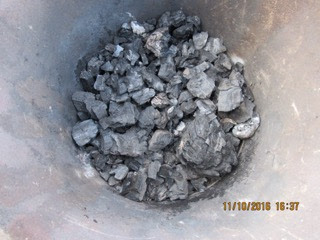
Don Morrison reports: "The 55 gal reservoir is just the right volume for quenching the coals from the 5' kiln by raking and spraying. I also liked the ease of tipping the kiln and dumping by one person with cable attached to handle and 4-wheeler. Next I tried the dry snuff method using the lid sealed with dirt. I use a little bit of water to knock the flames down and then put the lid on. Came back the next day and there were still a few hot spots that need some water to put out. But the char was basically pretty dry. Dry char is lighter and easier to unload than wet, sticky char."
 |
| This is how we burn slash in the Oregon Kiln |
 |
| 55 gallon water tank was enough to fully quench this 200 gallon kiln if you dump, rake and spray |
 |
| An alternative to water quench is the dry snuff. Add a little water to cool initally and then place the lid. Seal the lid with dirt and wait overnight. |
Wednesday, November 16, 2016
New Biochar Kiln with Turbulator is a Thing of Beauty
A new device from ace inventor Scott McKain:
I have added a turbulator to the exhaust to produce a cleaner burn. It is cut from a piece of stainless and mounted to the wok cowling. Visually it works well. Notice the feedstock is almost cordwood size. I plan to build a similar unit for radiant heat and hot water.

I have added a turbulator to the exhaust to produce a cleaner burn. It is cut from a piece of stainless and mounted to the wok cowling. Visually it works well. Notice the feedstock is almost cordwood size. I plan to build a similar unit for radiant heat and hot water.
Here are the pics:


NRCS New CSP Program Includes Biochar
While it is not mentioned in this press release, the new CSP program includes payments for making biochar from woody waste. If you are interested in enrolling in the CSP program, contact your local NRCS office.
Release No. 2016.11.005
Contact:
NRCS launches new and improved Conservation Stewardship Program
Apply by Feb. 3 with the Natural Resources Conservation Service
Portland, Ore., Nov. 15, 2016— The nation’s largest voluntary conservation program is getting even better this year with the launch of the new and improved Conservation Stewardship Program (CSP), administered by the USDA Natural Resources Conservation Service.
CSP helps farmers, ranchers and family forest owners maintain their existing conservation efforts and adopt additional activities to address natural resource concerns.
“CSP provides incentives for farmers who are already being good stewards of the land and helps them take their conservation efforts to the next level,” said State Conservationist Ron Alvarado. “The changes to the program will give participants more flexibility and choices to adopt conservation enhancements that fit their operation, plus the program will be more transparent and understandable for producers.”
NRCS is now taking applications for the 2017 CSP sign-up. The sign-up deadline for 2017 funding is Feb. 3. Applications can be submitted at a local USDA Service Center.
In Oregon, CSP applications will be ranked and prioritized for funding within five geographic zones. Eligible applications within each zone will be evaluated based on national, state, and local ranking questions. Read more on the Oregon CSP webpage.
NRCS Oregon enrolls an average of 300,000 acres of working agricultural lands into CSP every year and pays an annual average of $6 million to program participants statewide.
Nationally, NRCS has enrolled 70 million acres of working agricultural lands into CSP. This translates into thousands of farmers and ranchers who have made the choice to voluntarily enroll in the program because it helps them enhance natural resources and improve their business operation.
NRCS has made several changes to CSP this year, which include:
• Focus on Conservation Planning: CSP now integrates conservation planning logic from start to finish. CSP helps producers better understand what resource concerns are being addressed on their agricultural operation and identify opportunities to address additional resource concerns.
• New Screening and Ranking Tools: NRCS developed new tools to determine stewardship eligibility and rank applications. These tools make the application process more transparent, logical and easy to understand.
• Additional Enhancements: NRCS has nearly doubled the amount of enhancements (more than 200) available for producers to choose from, which gives participants more flexibility to choose conservation activities that best suit their operation.
• Consistency in Payments: CSP payments have been re-structured using consistent, straightforward calculations. Payments to implement additional conservation activities will follow set payment schedules similar to other NRCS financial programs.
For more information and to apply, contact a local USDA Service Center or visit the NRCS Oregon website at www.or.nrcs.usda.gov.
For the latest CSP information and updates, visit the national CSP website.
Subscribe to:
Posts (Atom)